Can It Truly Be Called a Tear? When AI Feedback Is Not the Final Judgment — A Teaching Reflection from a 180-Student General Education Course
By Hui Gao | Associate Professor, School of Landscape Architecture, Beijing Forestry University, China
A student submitted an assignment with a question I had not expected:
If a liquid closely resembles a tear in its chemical composition, temperature, and pH value, can it truly be called a tear?
This question did not come from AI. It existed before she opened any tool. That matters.
About the Course
Art Perception and AI Visual Literacy is a university-wide general education elective at Beijing Forestry University. This semester, around 180 students from different majors enrolled, most without formal art training. The course covers Chinese art traditions, Western art history, and contemporary art practices. AI is not the subject of the course — it is a tool that helps students turn abstract artistic questions into something visible, comparable, and open to discussion.
As AI becomes increasingly capable of generating images that look finished, one teaching problem becomes harder to ignore: the final image can tell us only so much. On its own, it is far from sufficient to show that learning has taken place. What truly matters is what happens before, during, and after the image is made.
The First Version
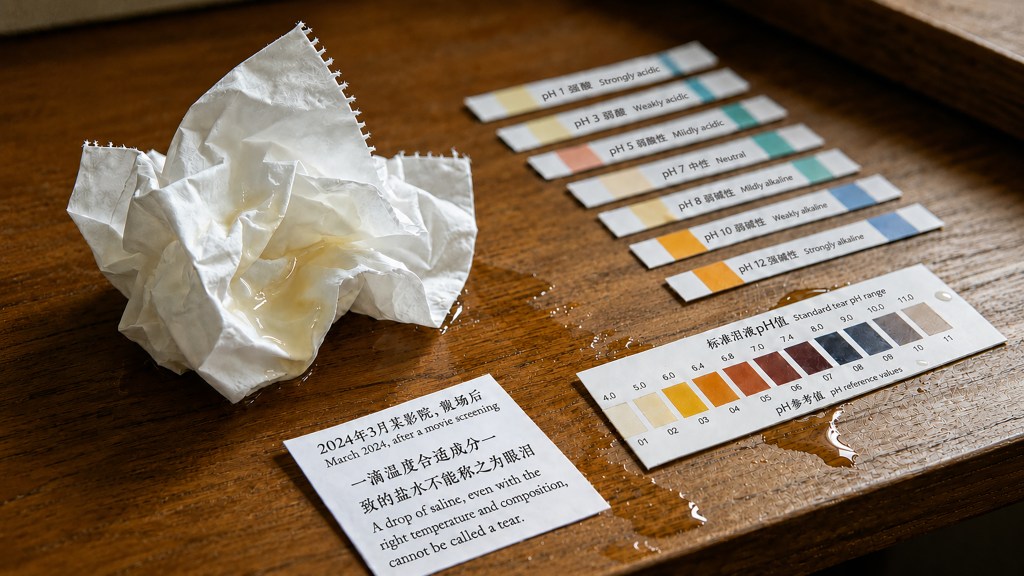
The student’s initial concept was already clear: a crumpled tissue, a semi-dried water stain, several pH test strips showing different values, and a small card reading “March 2024, after a movie screening.”
She already understood the central tension in the work: the gap between measurable evidence and emotional experience. A pH strip can tell us the acidity of a liquid. It cannot tell us why someone was crying — or even whether the liquid was a tear at all.
In the first round of AI-generated images, the faint water stain she had imagined became a visible puddle, and the liquid appeared yellow rather than transparent. Recognizing the gap between the generated image and her original vision, she asked AI to identify weaknesses in the concept and suggest how the work might become more restrained and thought-provoking.
What AI Got Right — and What the Student Questioned
The AI feedback identified two problems.
First, AI pointed out that the specific note — “March 2024, after a movie screening” — over-explained the work. Viewers would likely assume immediately that this was a tear shed after a film. The work seemed to answer its own question before viewers had a chance to reflect.
The student accepted this criticism, but she questioned what it implied: did making the work more restrained mean removing all verbal cues? Without any hint, viewers might not understand why the water stain on the tissue had anything to do with tears. So she removed the specific time, place, and event, and replaced the cinema note with a more open question:
“Can you prove where this drop came from?”
This no longer tells viewers that the liquid is a tear. Instead, together with the tissue and pH strips, it offers a way into the work: the liquid may be related to a tear, but that judgment remains for the viewer to make.
Second, AI noted that a large number of pH test strips, if scattered or stacked, could easily create a “laboratory aesthetic” — drawing attention to the quantity and visual form of the strips rather than the emotional experience the work was actually exploring.
The student accepted this assessment and adjusted the number and arrangement of the strips accordingly. She kept the strips as evidence of measurement, but controlled their visual weight so they would not become the center of the work — and so the work would not collapse into a simple question of whether the measurement had succeeded.
This is the moment I find most valuable. The student did not treat AI’s feedback as a ready-made revision plan. For the first problem, she questioned whether the only solution was to remove all verbal cues entirely. For the second, she accepted the risk AI had identified but made her own decision about how many strips to keep and how they should appear.
What She Found That AI Had Not Raised
While working through the feedback, the student identified something AI had not adequately noticed: the work needed to draw viewers more directly into the question.
Simply placing a tissue and some test strips on a surface — however carefully composed — might leave viewers standing at a distance. But if the work was asking whether emotion could be proven through data and evidence, viewers should not remain outside the question.
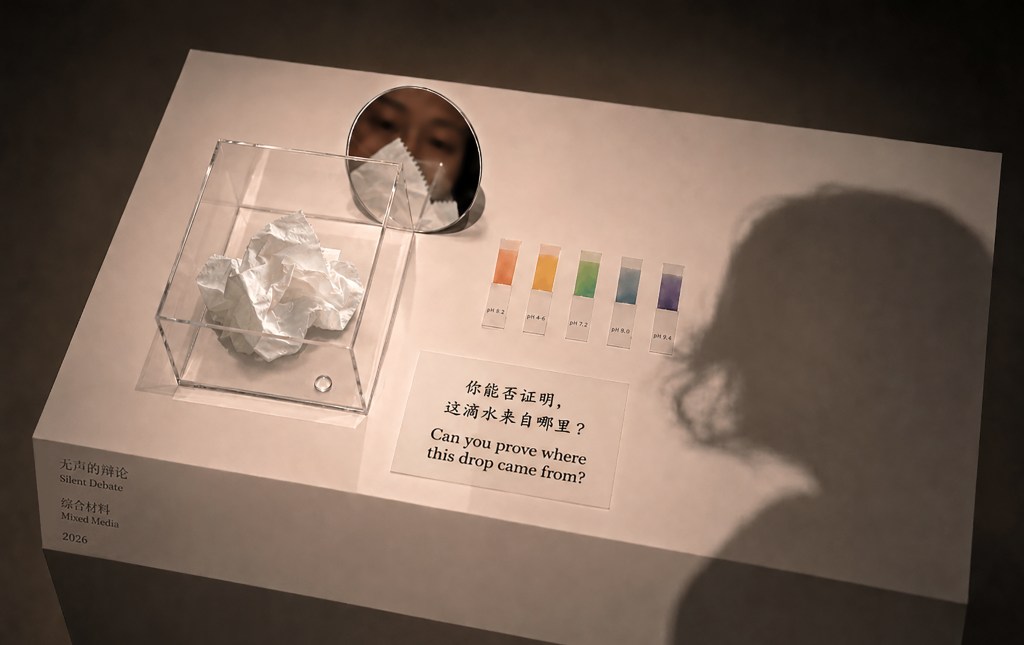
She added a round mirror.
In the revised proposal, as viewers approach the work, their own face and shadow enter the visual field. The question card reads:
“Can you prove where this drop came from?”
The final proposal is shown in Figure 1. The shadow in the image represents anyone who might stand before the work and try to answer. The mirror is not simply decorative. As viewers search for evidence, they also see themselves. The act of looking becomes part of the work.
What This Means for Teaching
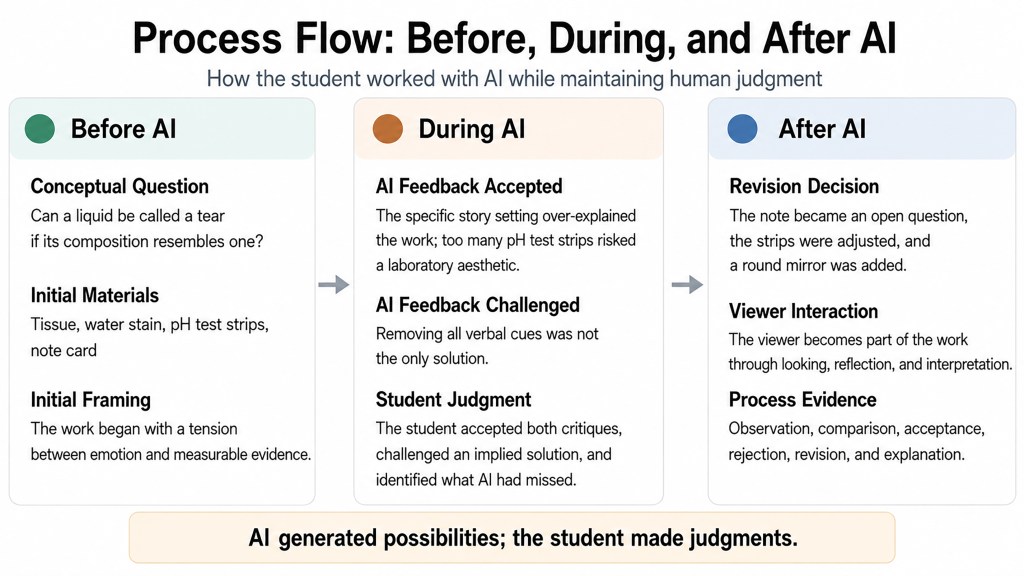
This case helped me see a recurring learning structure more clearly. Before using AI, students form their own questions and initial judgments. During their interaction with AI, they compare, accept, challenge, or revise feedback. After AI enters the process, they still need to make decisions and explain why those decisions matter.
The AI-generated image is only one node in that process. The student’s judgment runs through all of it. In a course of 180 students from different disciplines, this kind of process evidence also allows the instructor to see learning that goes beyond the finished image — rather than evaluating work based on its apparent completeness alone.
Why This Case Stays With Me
The final image alone is not sufficient evidence of learning. Other evidence matters just as much: the question the student began with, the prompts she used, what AI generated, which feedback she accepted, which she questioned, and how she explained her revisions.
This student made at least three significant judgments. Before opening any AI tool, she had already formed her own question. She accepted AI’s criticism of over-explanation, but did not simply remove all verbal cues; instead, she replaced the specific narrative with a more open question. She also responded to AI’s concern about the test strips by adjusting their number and visual weight rather than removing them entirely. Finally, she identified a dimension AI had not raised: the presence of the viewer, and the uncertainty that remains when evidence alone cannot provide an answer.
AI generated possibilities. The student made judgments.
This is what I am trying to teach — and what I am still working out how to assess. The final image is no longer enough. We also need to see the thinking that made it what it is.
This post is part of a series of classroom notes from Art Perception and AI Visual Literacy. Student work and process materials are used anonymously with permission. Figures 1 and 2 are AI-assisted visualizations developed from the student’s evolving proposal and process materials, with visual refinements made for clarity and publication. Figure 3 was developed by the author to summarize the student’s process.
About the Author
Hui Gao is an Associate Professor in the School of Landscape Architecture at Beijing Forestry University, China. Her work focuses on AI-assisted visual literacy, art perception, and process-based assessment in large-scale general education courses for non-art majors. She was a Visiting Scholar at the Bernard and Anne Spitzer School of Architecture, The City College of New York, CUNY, from 2024 to 2025.
Department profile: https://sola.bjfu.edu.cn/cn/teachers/office/fjs/379002.html
LinkedIn: https://www.linkedin.com/in/hui-gao-visual-literacy
 Expressive AI
Leave a comment