by Clone Wen (originally written in 2024 for prof. Hassapopoulou’s Cinema & the Digital Humanities graduate seminar)
The relationship between “artificial” and “intelligence” in the Anthropocene is complex. Interesting tensions have been debated between its computational intentionality and the mimicry towards animism, especially when examined through Asian frameworks of Buddhist animism landscapes. Drawing on Lev Manovich’s critique of AI in media and May Adadol Ingawanij’s idea of “animism media,” this essay challenges anthropocentric interpretations of “intelligence” by proposing “animism intelligence.”
1 . Artificial Intelligence
The boundaries between human and machine intelligence are increasingly blurred in CGI actors. In the article Al-aesthetics and the Anthropocentric Myth of Creativity, Lev Manovich’s discussion of virtual idols in East Asian cultures suggests that fans project their desires and imaginations onto the virtual avatar, in awareness of the avatar’s obvious “fakeness”. This generalization, however, limits the virtual avatar to a phenomenon confined to East Asia, especially Japan, and overlooks its broader application in terms of “Western”, particularly in Hollywood. The concept of “fakeness” is not exclusive to the metahuman production pipeline of digital idols, instead, all digitally scanned actors are “unreal” actors, especially those in the CGI productions of Hollywood blockbusters. As Manovich pointed out, virtual idols have made a fluid transition from “as if” to “real.” This transition from “as if” to “real” is rooted in the performativity of virtual realities. As Diana Taylor’s introduction in her book Performance, “performance moves between the ‘as if’ and the ‘is’, between the pretend and new constructions of the ‘real’“ (Taylor, 8).
Not only in Japan, but in VFX commercial films around the world, all stars, extras, and characters have become computer-synthesized characters, hence artificial puppetry, and mimicry with generated and calculated motion capture, except that their voices are real performances. Linda Powell, executive vice president of SAG-AFTRA, discussed the 14-page agreement negotiated by SAG-AFTRA from the 2023 Hollywood strike that protects the copyright of actors’ digital scans and the principle of 48-hour notice in her talk titled ‘‘The Agreement That Changed Hollywood’’ at Villa Albertine’s Art in the Age of AI symposium. As Linda Powell concluded in her talk, one unresolved issue in the SAG-AFTRA agreement is the copyright of voice performances and motion captures beyond the digital double’s virtual body. This illustrates that virtual idol’s “as if” to “real” has also lied in the actor’s vocal performances. Just a month after Powell’s talk, Scarlett Johansson sued OpenAI for infringing on her vocal likeness, highlighting this emerging issue.
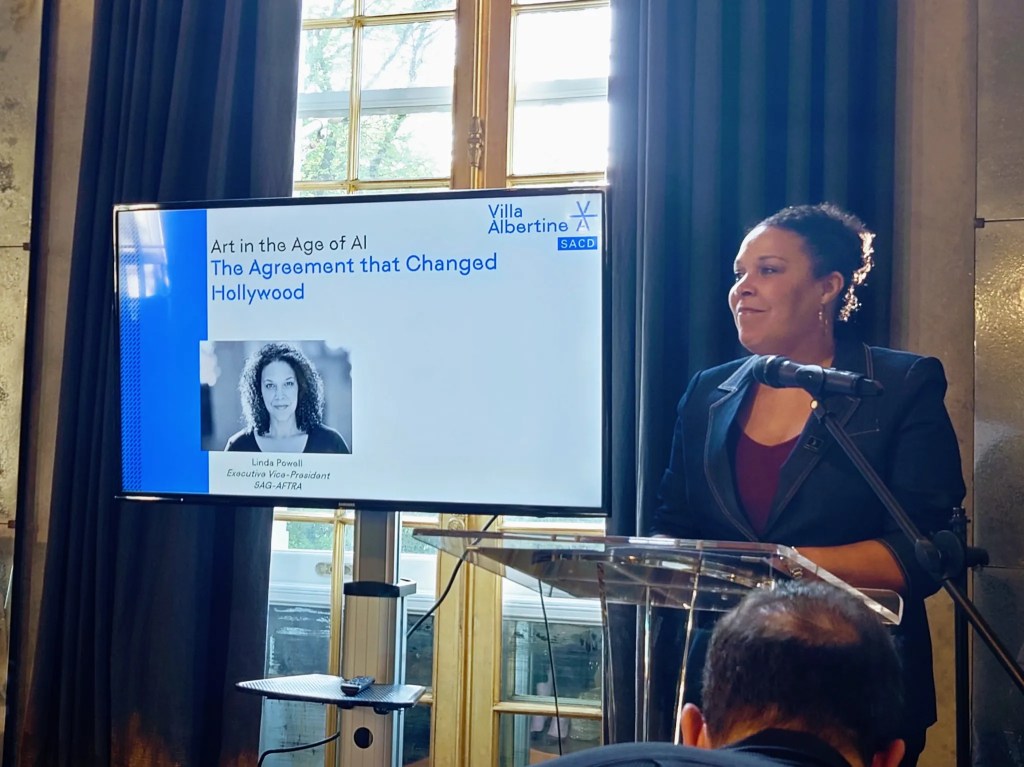
All the overrepresented internet characters — not only idols, but also users posts, influencers and opinion leaders, in their trivial interactivities — are more-or-less artificial avatars. While artificial actors and performances have already quietly emerged, a central question raised by Manovich is the relationship between ‘artificial’ and ‘intelligence’. In the posthuman Anthropocene, where human is inevitable in the animism landscapes, he questions whether the “artificial” also belongs to the inhuman or the non-human.
However, Manovich’s writing and understanding have also fallen into the trap of an anthropomorphic view. In his example of overcoming cultural prejudices, he notes that “we would still rather give intentionality to an insect than to Alexa.” But humans have never “given” intentionality to an insect in the same way they have “given” it to Alexa, instead humans have “learned” and “imitated” insects to create artificial intelligence like Alexa. Animism, as Kant conceptualized, is the “thing in itself” (Ding an sich), which remains an agnostic existence that can only be explored but not influenced by human intentionality. Artificial intelligence, therefore, could be seen as merely a projection, attribution and mimicry of animism landscapes. Yet artificial Intelligence is still never genuinely “animism” nor “intelligent”, unless it transcends the anthropocentric myths.
2. Artificial Animism
Discussions of “intelligence” are often rooted in Western anthropocentric cultures of human cognition and creativity. This discourse overlooks alternative interpretations of “intelligence”, such as those found in Southeast Asian, South Asian and Tibetan animism in its Buddhism cultures, where intelligence is embedded in non-human entities, and spiritual landscapes.
In essence, artificial intelligence is largely the “artificial of human intelligence”, and “artificial interactives towards intelligence”, or just “artificial interactives”. “Intelligence” itself is a term that has been codified, projected, overrepresented and continuously debated since Turing’s test in his article Computing Machinery and Intelligence. It is important to note that the Turing Test is, a game. An interactive game, between human and computing machine. An imitation game, to be played by computational machinery in its imitation of human consciousness, so that the computational machinery itself becomes a game of attraction to human beings. The imitation game, then, also share similarities to the “cinema of attractions” coined by Tom Gunning on early cinemas. Just as moving images are two-dimensional projections of the three-dimensional world, the artificiality of “intelligence” also hoped to construct a three-dimensional Anthropocene projection and attribution from the ruins of animism.
In attempting to construct such machines, Turing also acknowledged intentionality towards the theological divinity of cognitions: ‘‘We be irreverently usurping His power of creating souls, rather we are, in either case, instruments of His will providing, mansions for the souls that He creates’’(Turing, 435) Towards the ‘‘intelligence’’, Turing had attempted to add the human influence in the ‘‘animism – human – computational machinery’’ hierarchy, if animism can be seen as a broader modernized theology.
Redefinition, iteration and representation of the word “intelligence” has led to the division between “animism” and “artificial”, establishing the hierarchy between “human” and “non-human”. As Manovich said, it has been a horizon line that can never truly be reached, or only as a marketing artifact. However, if we remove the term “intelligence” from “AI,” what remains is the human obsession with “artificial” — this artificiality of human creativity dominates the Anthropocene, stripping away spiritual connections to the land, ecology, and non-human beings.
In other words, “intelligence” refers to “animism” itself, for artificial intelligence is also the process of artificial animism. The naive, therefore, is not the ‘‘humanization’’ of non-human entities, but rather the “intelligence” of the human entity of the anthropocentric derivatives of the Turing tests. In this light, AI can be understood as an artificial, interactive intelligence towards animism, reimagined as “Artificial Animism”, one that moves beyond the confines of anthropocentric thinking and embraces the interconnectedness of all beings.
3. Animism Intelligence
“Animism Medium” is a term coined by May Adadol Ingawanij in the conclusion of her recent research and curatorial program, and in her forthcoming book on Southeast Asian moving images. During a 2019 project in Udon Thani, Thailand, Ingawanij curated the interactive screening event “Animistic Apparatus,” in which she built an alternative cinema in the suburbs around Buddhist temples. The project’s guerilla mode of rural screenings are not just art programs, but ritual acts, where spirits, humans, and the nonhuman world interact within the temporal and spatial dimensions of cinema. During the fieldwork, the filmmakers sought permission from the local guardian spirits before the event could proceed, engaging in a dialogue with the land’s spiritual inhabitants, guided by ‘‘Jaam’’ (like shamans, intermediaries between spirits).
This idea of cinema as a performative, interspecies communication ritual contrasts with Western approaches — “Film therefore becomes an ecology of sustained relations — a ritual of communicative exchange between spiritual beings entangled in multiple worlds, part of an apparatus for projection and human-nonhuman communication.” (Ingawanij, 86) In another case of the “Nang kae bon”, an ethnographic ritual has embodied nonhuman screenings as sacrifices to powerful deities of the Buddhist landscapes. On the other hand, in Jean Ma’s new book Sleeping in the Cinema, she details her participation in Apichatpong Weerasethakul’s interactive cinema SLEEP CINEMAHOTEL at the International Film Festival Rotterdam 2018. For 75 euros a night, she stayed in an exhibition space set up like a budget hotel for homeless shelters, where she slept in the collective space under a 24-hour non-stop screening by Apichatpong Weerasethakul, visually and acoustically. And she traces this experience back to the 1997 interactive cinema Sleep with Me by the artist Bik Van der Pol, which was set up in an exhibition space at the independent artists’ cooperative Duende in Rotterdam and equipped with 30 beds when the film Sleep was screening on 16mm. In these interactive experiments of cinema, film screenings become a walking pilgrimage, a funeral ritual for sleeping subconscious, or ghosts and spirits in the liminal space of night forests.
Last month, at the Rubin Museum of Art’s final exhibition on contemporary Tibetan Buddhism before it closed, I saw another interactive installation of the sensory mimicry of animism that transforms the museum into a living, breathing entity. It was John Tsung’s Divine Generation, a booth on the fifth floor in front of a Buddhist shrine that contains a heart-shaped stone inscribed with the words “Please Touch,” which resonates with vibration. The vibrations are, surprisingly, the footsteps on the stairs of all visitors as they walk up and down the six floors of the entire museum. Using piezo microphones, speakers and a network of cables inscribed with the Heart Sutra, Divine Generation channels the physical vibrations of the museum into sound, turning the spine of the building – the central staircase – into a resonating vessel. By touching the stone, one touches the museum’s resonating nerve and the footsteps of thousands of creatures who have walked on the spine – an experiential system in which the museum has become a larger spiritual organism. Reminiscent of the meditations in the cyclical nature, ‘‘intelligence’’ becomes ‘‘interactive’’, something experienced and embodied through ritual and spiritual communication.
In this context, interactive cinema becomes a performative act that appropriate on the spiritual world, blurring the boundaries between the human, the machine, and the nonhuman. In these films, the moving image is not merely a medium for storytelling, but an active participant in a larger cosmic web of interactivity. The performativity of animism landscapes resonates with Asian Buddhism, breaking the boundaries between screen, viewer, and environment, and pushing cinema into embodied experiences.
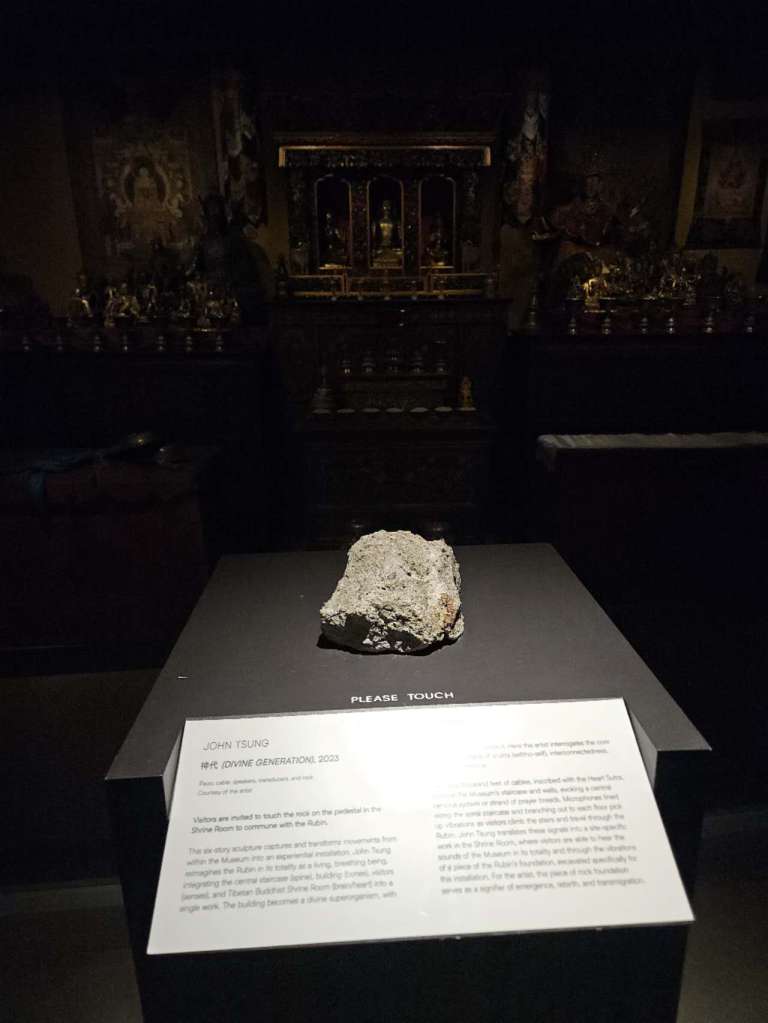
John Tsung, 神 代 (Divine Generation), 2024, piezo, cable, speakers, transducers
Click to visit the original post
Works Cited
Arielli, Emanuele, and Lev Manovich. “AI Aesthetics and the Anthropocentric Myth of Creativity.” Nodes: Journal of Art and Neuroscience, 1 Jan. 2022.
Carus, Paul. Kant and Spencer; a Study of the Fallacies of Agnosticism, by Dr. Paul Carus. Open Court Pub. Co, 1904.
Gunning, Tom. The Cinema of Attraction: Early Film, Its Spectator, and the Avant-Garde. 2000.
Hassapopoulou, Marina. Interactive Cinema: The Ambiguous Ethics of Media Participation. University of Minnesota Press, 2024.
Ingawanij, May Adadol. “Stories of animistic cinema” Antennae: The Journal of Nature in Visual Culture, vol. 1, Jan. 2021, pp. 85-97.
Ma, Jean. “Sleeping in the cinema.” October, no. 176, 2021, pp. 31–52.
Taylor, Diana. The Archive and the Repertoire: Performing Cultural Memory in the Americas. Duke University Press, 2007.
Turing, A. M. “Computing machinery and intelligence.” Mind, 1950, pp. 433-460.
Tsai, Beth. “To the future: Film festivals as producers and sleeping in the cinema.” Taiwan New Cinema at Film Festivals, 30 Apr. 2023, pp. 128–148.
 Expressive AI