Some of our favorite resources will be frequently updated below. Contact us to add your own or contribute a piece. Visit the Selected Resources page for more.
AI is entering classrooms faster than we’re teaching students how to critically think about it. Syllabi are being updated. Tools are being adopted. Policies are being written. Endless dead-end debates are being launched. But innovative critical pedagogy is often lagging behind. That’s why we launched the new Resources Hub on ExpressiveAI.net: a curated space for educators, institutions, and scholars who want to harness AI as a cultural, creative, collaborative, and thought-provoking impetus, not just a productivity tool. This isn’t a list of “best AI tools” (though we do offer some of those as well). It’s a frequently updated living resource designed to support:
• critical and ethical AI literacy
• creative experimentation as an integral part of critical literacy
• classroom-ready activities & lesson plans
• thinkpieces and edu-influencers to follow for interdisciplinary perspectives
• crowdsourced materials from some of the top AI educators
Because AI literacy without critical literacy will not fix an already broken system.
A long-standing resource that pre-dates our current AI landscape is the < Interactive Media Archive>, founded by Dr. Marina Hassapopoulou. The site has been around for some 15 years, and features innovative experimental student projects, teaching tips, resources, and assignment guidelines. The innovative aspects of the showcased student work are not primarily technical — ideas take the center stage, and the rest follows; the “ideas before tools” mantra should be extended to AI so as to approach it (them) from a tool-agnostic perspective. Public-facing scholarship and practice are important means of making student work visible and celebrated. Accessible means of production is also an important factor for cultivating inclusive learning environments. Many of the showcased projects on the Interactive Media Archive have been made using DIY, low- and no-tech/budget methods and, as a result, push the boundaries of what can be considered creative technology and what constitutes digital humanities. Visit the archive’s Resources page for more articles and lesson plans using digital technologies and hands-on approaches.
Besides the AI-focused projects for the Visualizations assignment that will be spotlighted separately, there are also some AI-focusedMedia Archaeology projects on the Interactive Media Archive that cover early artistic experiments with pre-historic forms of AI including our featured artist Toni Dove’s Sally or the Bubble Burst (2003) and Luc Courchesne’sPortrait One (Portrait No1, 1990 – still accessible online here alongside one of the first essays on “bot” art).
🛠 Regularly updated list of clickable AI pedagogy resources, projects, tools, & opportunities (marked with *)
- The AI Pedagogy Project – metaLAB at Harvard
- Harvard’s Teaching with Generative AI guide
- Teach AI
- AI Lab: Navigating Artificial Intelligence
- Creative AI Lab
- University of Cambridge’s Leverhulme Centre for the Future of Intelligence
- Edinburg Futures Institute database & Experiential AI project
- New York University’s “AI Now” Institute
- The Future of Being Human Initiative (Arizona State University)
- Columbia Storytelling Lab
- Playlab – easy software creation for educators (e.g., chatbots and other tools)
- Futuress.org: a vibrant online/hybrid community where feminism, design, and politics meet — check out their #curricula for lesson plans and pedagogical activities
- Educause’s AI Ethical Guidelines
- AI x Design
- We and AI – Critical literacy non-profit organization that also launched Better Images of AI, Race and AI Toolkit, & other useful resources.
- Center for Responsible AI: Teaching & Education
- Indiana University School of Education’s Generative AI Framework (2026): a human-centered blueprint for how we can use GenAI in teaching, learning, research, and operations with integrity.
- ESRC Digital Good Network: Research, collaboration, and opportunities hub**
- Schmidt Sciences’ Humanities and AI Virtual Institute – includes funding opportunities and calls for applications such as this one.**
- The AI Collective: An expansive non-profit grassroots community that includes initiatives, projects, events, partnerships & other resources. **
- IDEO’s Edges: “A place to experiment, to explore our own craft. To be an engine of continued, rigorous explorations of humanity and experiments with technology.” Even just casually browsing Edges gives plenty of food for thought and discussion.
- Carrier Bag is a socioculturally and politically-engaged multimedia platform.
- HUMAIN multidisciplinary network
- Artificiality Institute & journal
- The Portrait of a Teacher in the Age of AI
- International Center for Academic Integrity (ICAI)
- Academic Justice League (AJL): Unmasking AI Harms and Biases
- Environmentally-conscious use of AI and assessing AI’s carbon footprint: What Uses More (John Ippolito) & Susan Ray’s Carbon Footprint Chatbot (pair well withthis video). For reference, this is NYU’s AI & Sustainability guide & the Resources page.
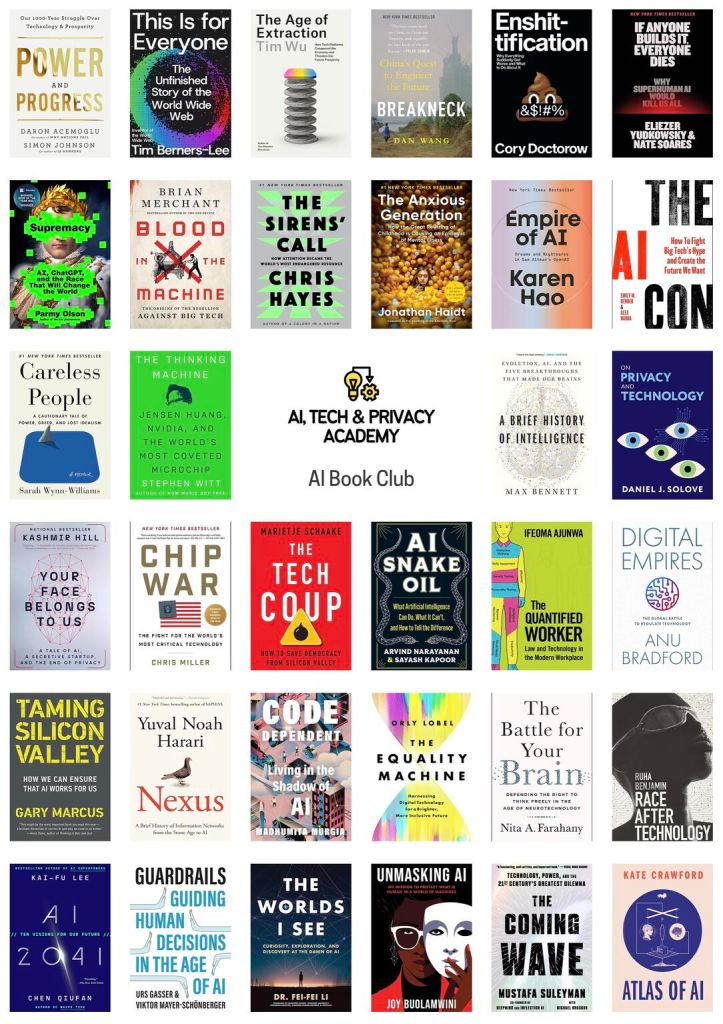
- Luiza Jarovsky‘s free AI Book Club
🧠 Activities, Lesson Plans, & Classroom Resources:
- Interactive icebreaker: Wired magazine’s “AI of a Thousand Faces”
- Creative prompt builder template (thanks to this Creative Mornings workshop)
- Brainstorming template (see more from Echoes of Panda on Notion)
- Create custom chatbots using Playlab tutorial by Jason Gulya
- Creating AI characters tutorial by Mike Kenz
- IDEO’s Edges offers several creative activities, including “Can you build a planetary impact tracker in one day?” and “AI and Creative Companionship” workshop that includes their customizable GPT.
- Environmentally-conscious use of AI and assessing AI’s carbon footprint: What Uses More (John Ippolito) & Susan Ray’s Carbon Footprint Chatbot (pair well withthis video). For reference, this isNYU’s AI & Sustainability guide & the Resources page. >> From John Ippolito via LinkedIn: “In a feature entitled How AI Is Sparking Unexpected Conversations in Classrooms, the Mark Cuban Foundation notes that ‘One conversation among students that our teachers are reporting back to us about is how AI is impacting our environment…it’s certainly a dialogue we need to engage in and continue to revisit.’ Built from publicly available data, What Uses More lets you adjust key variables, from how complex your prompt is to the kind of energy powering the nearest data center and even the local climate it operates in. Susan Ray’s Carbon Footprint works similarly, except that the interface is a chatbot rather than a calculator. My favorite classroom application is an equivalence challenge: how many three-second AI-generated videos would you need to equal the energy demand of a single hour-long Zoom call? The goal isn’t to memorize numbers, but to notice how dramatically the answer shifts with each change in circumstance, and thereby to learn the factors that go into AI’s energy and water costs.”
- “Keeping Ourselves in the Loop: 6 Activities for a Human-Centered AI Pedagogy,” by Carter Moulton (Inside Higher Ed)
- QUILI.AI: Analog Intelligence: Chile-based environmentally-conscious initiative against unnecessary use of AI
- New podcast: The Interface, hosted by Thomas Germain, Karen Hao and Nicky Woolf (BBC Studios)
- Experimental & Creative Workshop Examples:
- Beginner: IDEO’s Edges “Warming Up to AI” workshop (with parrots!)
- Edges’ “AI and Creative Companionship” workshop for book-making using AI tools
- Teachers College, Columbia University – “Text to Video: Creating Experimental Art with Generative AI” (led by artists Fabiola Larios & Moises Sanabria): a hands-on session where participants created video art from text prompts using generative algorithms.
- Adobe’s “Make It with Generative AI” workshop series: artists were challenged to experiment with generative tools, remixing forms in a two-day jam environment, focusing on process & discovery rather than final polish.
- Realitycraft’s “Generative Creativity: Making Worlds with AI Tools” (5-week cohort): concept development, tool exploration, world-building for artists/creatives using generative media.
- The New School Innovation Center’s “Generative AI Workshops” for image/video/audio production; focuses on experimentation with AI in creative disciplines.
⚖️ Learning Assessment & AI Regulation in the Classroom (in progress):
- Use the drop-down menu for case studies and sample assignments from Marina’s courses
- For more suggestions and thoughtful insights, check out the books, articles, and influential educators list below.
- “What Are We Really Assessing: Rethinking Evidence of Learning in the Age of AI,” by Joanne Villis
- “Six Territories for Disciplinary AI Literacy,” by Nick Potkalitsky
📚 Articles, Books, & Reports (regularly updated):
- GenAI in Higher Education: Redefining Teaching and Learning by Sam Illingworth and Rachel Forsyth (Bloomsbury, 2025). *Open access*
- What Education Becomes: Teaching and Learning in a Post-AI World (forthcoming, 2026)
- The Artificiality: AI, Culture, and Why the Future Will Be Co-Evolution by Helen Edwards (2026)
- The Opposite of Cheating: Teaching for Integrity in the Age of AI by Tricia Bertram Gallant and David A. Rettinger (University of Oklahoma Press, 2025).
- AI and the Future of Education: Teaching in the Age of Artificial Intelligence by Priten Shah (2023).
- The AI Classroom: The Ultimate Guide to Artificial Intelligence in Education by Daniel Fitzpatrick, Amanda Fox, and Bradley Metrock (2023).
- Teaching with AI: A Practical Guide to a New Era of Human Learning by José Antonio Bowen and C. Edward Watson (Wiley, 2025).
- Co-Intelligence: Living and Working with AI by Ethan Mollick (Penguin Press, 2024).
- The Creative Edge: How AI Will Transform Education and Creativity by Henry Li (Routledge, 2025).
- The Future of Learning: Education in the Age of AI edited by James Hadfield & Andrew Kuiper (Routledge, 2024).
- AI for Education: Teaching, Learning, and Research in the Age of Artificial Intelligence edited by Wayne Holmes and Kaska Porayska-Pomsta (Springer, 2024).
- 21st Century Literacies with AI: Critical Perspectives for Teachers edited by Tiffani Hutchinson & Katie Schaefer (Routledge, 2025).
- Artificial Intelligence in Education: Promises and Implications by Education Design Lab (2019, foundational early report referenced widely in policy).
- AI Literacy: Developing Critical Thinking About AI by Megan Del Vecchio (MIT Press, 2025).
- Teaching in the Post-AI Classroom: Rewriting Pedagogy for a Hybrid Future by Paul Handley (Routledge, 2024).
- The Creative Imperative: AI, Imagination, and the Future of Learning by Lanny Arvan (Springer, 2025).
- The Eye of the Master:A Social History of Artificial Intelligence by Matteo Pasquinelli (Verso, 2023).
- AI and Academic Integrity: Designing Ethical Classrooms by John Palfrey and Margaret Hagood (Rowman & Littlefield, 2024).
- Human-AI Co-Creativity: Exploring Synergies Across Levels of Creative Collaboration by Haase et al. (2024).
- How AI Ideas Affect the Creativity, Diversity, and Evolution of Human Ideas by Ashkinaze et al. (2024).
- Artificial Intelligence in Creative Industries: Advances Prior to 2025 by Anantrasirichai et al. (2025).
- Surfing Human Creativity with AI — A User’s Guide by Naoto KUI (Qosmo, 2023).
- The Artist in the Machine: The World of AI-Powered Creativity by Arthur I. Miller (MIT Press, 2020).
- Extended Creativity: A Conceptual Framework for Understanding Human–AI Creative Relations by Gaggioli et al. (2025).
- Eight Essential Books About AI and Art (ArtNews curated list, 2024).
- Tactical Publishing: Using Senses, Software, and Archives in the Twenty-First Century by Alessandro Ludovico (MIT Press, 2024). *open access*
- Ways of Being by James Bridle (2022).
- List of fiction and non-fiction: “Scared of AI? 11 Essential Books for Navigating our New Normal” (2025)
💡 Opinions & Thinkpieces:
- “I, Not the Author: Lamentations at the Edge of the Page,” by Bayo Akomolafe (2025)
- “How AI Is Rewriting The Future Of Humanities Education,” by Mary Hemphill (2025)
- “Generative AI in dissertation writing: L2 doctoral students’ self-reported use, AI-giarism, and perceived training needs,” by Mohammad Hamed Hoomanfard & Yaser Shamsi (2025)
- “Why AI Requires Universities to Do What They Were Built For,” by Helen Edwards (2025)
- “What’s at Stake: Preserving What Makes Us Deeply Human in the Age of AI”, by the Center for Humane Technology, Camille Carlton, and Julie Guirado (2025)
- ” ‘Artificial Ignorance’ and Data Sycophancy” by Cathy Davidson (2026)
🎲 Interactive Publications:
- Slow AI – Leonardo special issue
- IDEO/ Edges AI Variety Show – click here to see all hallucinations
- ContraSTS journal
- Game Poems Magazine – an online playable magazine dedicated to exploring the artistic and poetic potential of short-form videogames
- The AI Art Magazine
📢 Recommended Newsletters, Substacks & Social Media/ LinkedIN EduInfluencers:
- AI for Education: Pedagogically oriented AI resources for educators.
- Tech Policy weekly newsletter
- AIxDesign‘s newsletter
- AI & Arts Commons: Monthly newsletter & calls based at The Alan Turing Institute.
- Evolving AI community & news letter
- Jason Gulya’s The AI Edventure: An important exploration of cutting-edge innovations in AI-responsive curriculum and pedagogy.
- Kate O’Neill‘s “tech humanist” newsletter.
- Jon Ippolito, Professor of New Media and Director of Digital Curation at the University of Maine; explores archives, media & AI.
- Douglas Rushkoff, Technology/culture critic exploring human agency in AI age.
- Geert Lovink, Dutch media theorist and internet-culture critic; founding Director of the Institute of Network Cultures, exploring how digital media, archives and AI influence creative and educational practice.
- Susan Ray, a prolific advocate for the ethical integration of AI into education.
- Sarah Gibson, AI Strategist and Educational Consultant
- Eryk Salvaggio‘ s Cybernetic Forests newsletter for anything related to creative and experimental AI, with valuable policy-related and ethical insights.
- The Pragmatic AI Educator newsletter by Nick Potkalitsky — Bookmarked article: “Why ‘Think Critically About AI’ isn’t enough.”
- Joanne Villis, Director of Technology Enrichment.
- Mike Kentz’s AI EduPathways: Insights from one of our most insightful, creative, and eloquent AI educators in the business.
- Terry Underwood’s Learning to Read, Reading to Learn: One of the most penetrating investigations of the intersections between compositional theory, literacy studies, and AI online.
- Suzi’s When Life Gives You AI: A cutting-edge exploration of the intersection among computer science, neuroscience, and philosophy
- Alejandro Piad Morffis’s The Computerist Journal: Unmatched investigations into coding, machine learning, computational theory, and practical AI applications
- Michael Woudenberg’s Polymathic Being: Polymathic wisdom brought to you every Sunday morning with your first cup of coffee
- Rob Nelson’s AI Log: Incredibly deep and insightful essay about AI’s impact on higher ed, society, and culture.
- Michael Spencer’s AI Supremacy: One of the most comprehensive and current analysis of AI news and trends, featuring numerous intriguing guest posts
- Daniel Bashir’s The Gradient Podcast: The top interviews with leading AI experts, researchers, developers, and linguists.
- Shae O. Omonijo‘s critical thinking in the age of AI newsletter and resources.
- Rebecca Bultsma, AI ethics researcher & responsible AI adoption strategist.
- Daniel Nest’s Why Try AI?: Regular updates on AI tools and techniques.
- Tiera Tanksley, AI Ethics in Education, 100 Brilliant Women in AI Ethics 2024, 2024 MacArthur + OpEd Public Voices Fellow: Technology in the Public Interest
- Andrew Ng, Leading AI educator; accessible training & applied AI insights.
- Demis Hassabis, DeepMind CEO; key voice in AI research & ethics.
- Sinead Bovell, Futurist focused on AI literacy & inclusive tech education.
- Nathan Lambert, AI safety researcher; strong educator on ML fundamentals.
- Zain Khan’s Superhuman Newsletter: Daily breakdowns of AI tools, productivity & workflows.
- Ruben Hassid: Practical tutorials on Midjourney, ChatGPT and creative AI.
- Jeff Bullas: Thought leader on digital media + AI-driven content strategy.
- Kitty Wheeler: AI marketing/education insights; curates top influencer lists.
- Dave Birss: Co-Founder at The Gen AI Academy; focused on creative + applied AI education.
- Sarthak Ahuja: Featured in “Top 20 AI Educators on Social Media (2025)”; shares tools, workflows & learning.
- Carter Moulton: Creator, Analog Inspiration, Faculty Developer & Facilitator
- Raghav Gupta: INSEAD-trained executive heading education initiatives for OpenAI in India/Asia-Pacific, linking AI & learning systems.
- Kevin Barenblat: Co-Founder of Fast Forward; writes the “AI for Humanity” newsletter bridging AI, education & social impact.
- Helen Edwards: Co-Founder of the Artificiality Institute, writes about “human experience in an increasingly synthetic world”
- Joseph Gordon-Levitt: Actor-turned-HITRecord businessman-turned AI policy activist
- Send us your recommendations, this is not a comprehensive list!
*Credit to Nick Potkalitsky for part of this last list.
Some book recommendations from Luiza Jarovsky‘s free AI Book Club :
Header image credit: Rick Payne and team / https://betterimagesofai.org / https://creativecommons.org/licenses/by/4.0/
 Expressive AI
Leave a comment