by Vince Wen – originally posted here.
Douyin, TikTok’s sibling app in mainland China, shares the familiar short-video scroll but reorganizes reception around live infrastructure. At the center is the voice room (yuyinting): an audio-first setting for singing and banter where recognition runs through a payments interface. Viewers purchase virtual gifts with in-app currency; head-to-head PK battles unfold on countdown clocks; leaderboards and animated effects convert applause into visible spend. Performance becomes checkout, and fandom becomes a micro-market.
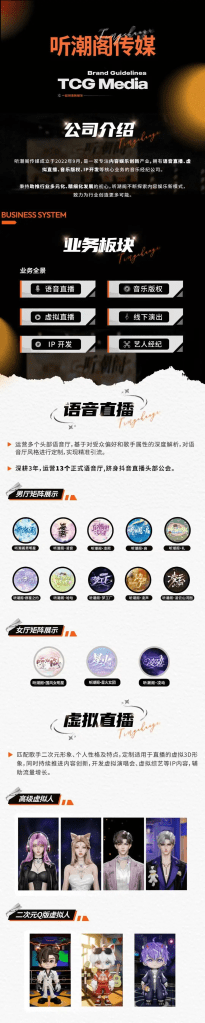
TCG Media (Tingchaoge Chuanmei) composes for this environment. The studio curates men’s and women’s halls of singer-streamers, stabilizes persona with virtual avatars, releases original music, and extends its worlds through offline concerts and merchandise. Read as a single pipeline, shorts seed discovery, avatars lower face-exposure risk and keep a visual bible coherent, songs add catalog value, and everything bends back toward the live room where revenue actually clears.
The economic center is unambiguous. Live tipping is the primary income. Fans brush gifts to request specific songs from specific hosts, turning repertoire into a priced, participatory menu. They tip to push a favorite singer over the line in a PK duel. They tip to hear their usernames read with extravagant thanks during rolling shout-outs in the voice room. Hosts learn the tempo of this economy: teasing a chorus, staging time-boxed challenges, stretching a cadence so that a splash of gifts lands on the downbeat. When gifts arrive in waves, the room hums; when the wave stalls, the same set suddenly feels unfinished.
TCG’s public deck celebrates virality in shorts, cumulative streams for the album YOUR CITY·新境, and a small pantheon of plush and acrylic merch. The numbers matter less as settled truth than as promissory metrics, claims that organize labor ahead of independent verification. Halls are staffed, avatars commissioned, shoots scheduled because slides promise scale; the promise is already part of the product.
For readers used to YouTube Super Chats or Twitch donations, the differences are not merely cultural but generic and choreographic. Douyin’s voice rooms foreground singing rather than gaming; PK mechanics split audiences into two cheering squads under a two-minute clock; gift effects escalate collectively rather than privately. The host narrates the swell in real time so that money and music share the same bar line.

The pipeline also travels offline. According to senior contacts, TCG’s anniversary concerts have sold out, which matches the scale of its fan base. Masked singers travel well because the mask or avatar guarantees timbre and temperament even when personnel rotate beneath the surface. Yet concerts expose a strategic dilemma. Do they deepen attachment or drain the pond, becoming short-term revenue spikes that depress future demand. The same uncertainty shadows paid traffic (touliu) on Douyin. Buying impressions can lift a short or a stream into visibility, but return on investment is meaningful only if those impressions convert into durable room presence rather than one-off curiosity.
Volatility is structural. The recent house-collapse episode around the masked singer Wangzai Xiaoqiao, in which persona unraveled publicly, shows how precarious trust remains. When the mask slips, gifts slow. Agencies buffer risk with etiquette scripts, avatar continuity, and performer rotation; still, the system stays personality-dependent and rumor-sensitive. Platform governance compounds the uncertainty. Douyin’s rake on gifts is substantial, and policies on youth spending, excessive tipping, or acceptable speech can shift quickly and reset the room overnight.
Aesthetics follow infrastructure. Listeners rarely hear a raw microphone. Noise gating, pitch correction, and spectral smoothing—AI-adjacent postproduction by default—produce a portable gloss that survives unstable networks. The aim is less purity than auditory plausibility, a voice live enough to sustain the social contract of the room. Ethics belongs to the object rather than the appendix. Assistance should be disclosed; labor credited where avatars, setlists, and on-mic patter are jointly authored; minors shielded from countdown mechanisms engineered to trigger gift cascades. Within this economy, point-song gifting—the act of brushing gifts to request a specific song from a specific host—is not a trivial monetization trick but a formal device that reshapes authorship and arrangement.

A digital-humanities frame clarifies method. The brand deck, the live interface, and the afterlives of clips form a paratextual corpus in which metric widgets—PK timers, gift animations, pinned comments—do not decorate performance; they script it. Treating these elements as sources enables a computational hermeneutics that asks how infrastructural affordances co-author rhythm, timbre, and scene. Distant listening becomes a technique rather than a slogan: modeling gift-time distributions as signatures of social tempo, aligning lyrical segments with surge events to observe how a chorus becomes a payment vector, parsing caption grammars and on-screen text as prompting devices that train collective action. Close listening returns with greater acuity, now situated within an operational aesthetics in which attention and money are synchronized by design.
Methodologically the stance is infrastructural reading supplemented by trace ethnography. The deck functions as a mutable prospectus whose categories—plays, reads, conversions—shift across versions; versioning those claims and cross-referencing them with observable room behavior yields a public, citable record of how scale is staged. Reproducibility matters. Any code that parses logs, captions, or UI states should carry provenance statements and sampling rationales. Any visualization should declare its blind spots—shadow bans, throttling, moderation events—rather than gesture at totality.
Sustainability is best posed as an infrastructural risk surface. Revenue concentration in gifts exposes creators to platform rake, governance shocks around tipping, and rumor cascades in a persona-sensitive market. Offline sell-outs and traffic arbitrage complicate the ledger: concerts may deepen attachment or deplete future demand; paid boosts may lift impressions while failing to convert durable presence. A research vocabulary can register these tensions without prophecy: volatility exposure as sensitivity to rule shifts; an exhaustion index tracking gift concentration, session length, and repeat-viewer ratios; a diversification score marking the share of income not contingent on countdown theatrics.
In that light, TCG is less an outlier than an index of payments-first media. The voice becomes a stack; the avatar a ledger of contributions; metrics a mutable paratext that governs composition. One need not forecast the model’s future to describe its present with precision: a system in which affect is operationalized, scale is performed, and music’s sociality becomes computational without erasing the body that still sings through it.
Sources and acknowledgments: Metrics and images referenced here draw on TCG Media’s WeChat publicly circulated brand deck; emphasis on live tipping, point-song gifting, PK dynamics, offline demand, paid-traffic strategy, and current risks reflects fieldwork in Douyin voice rooms and conversations with a senior company contact. Treat unaudited figures as indicative rather than definitive
 Expressive AI