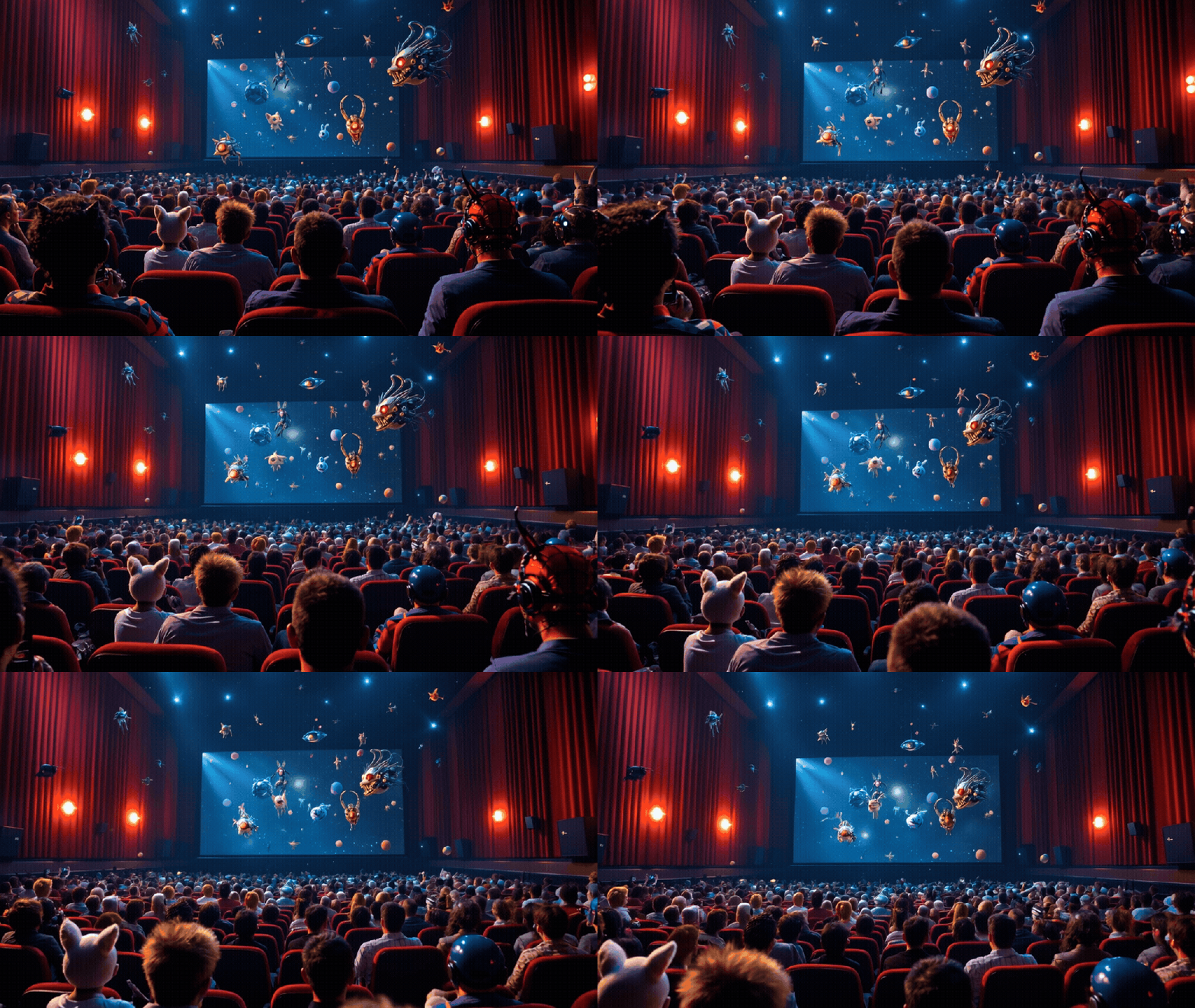
ExpressiveAI contains many projects that were made using what we would now call “primitive” AI, but we want to make some more room for newer media that exemplify ways of how AI can push creative boundaries and expand our cinematic imaginary. Below is Marina’s curated list-in-progress of relatively recent genAI videos that not only utilize AI in visually compelling ways, but also aptly use AI to make a statement. These videos are not “AI for AI’s sake” (the new and simplified “art for art’s sake” ?!?) and illustrate the ways in which a familiarity with film history and cinematic traditions, coupled with an inquisitive and critical mind, can produce new modes of human-AI co-creation that push the boundaries of what is possible. We prioritize substance over aesthetics for the selection of these AI videos, though they are definitely also cinematically impressive.
Eventually, this page will turn into a drop-down menu where we invite guest curators to share and premiere their favorite AI creations – stay tuned!
In no particular order, here are some of Marina’s standout online AI videos:
*more to be added soon*
🎬🤖The Cinema that Never Was by Mark Wachholz (2025). Mark Wachholz (@Magiermogul @Particle Panic) expands the potential of the video essay subgenre by thoughtfully using AI to pay tribute to films that were never conceived, poetically evoking cinema’s unrealized infinite potential. The Cinema that Never Was is a compelling self-reflexive example of how newer creative tools such as genAI can amplify–rather than diminish–our appreciation for older cinematic traditions, and makes a strong case for old and new traditions co-evolving together in surreal and magical ways. This video reminds me of Guy Maddin’s Seances (2016) that utilizes new technologies to pay tribute to lost and unrealized films. “What we watch and what we don’t watch, it’s all part of the same story; the archive of what’s real and the archive of what might have been.” – Watch Mark detail his process in a special behind-the-scenes interview with Curious Refuge.
🎬🤖 Clinical Panic by Dorothy Pang (2025). The use of AI in the making of Clinical Panic aptly fits the subject matter of the robotic and submissive housewife, with aesthetics reminiscent of classics such as The Stepford Wives and an element of retro futurism of newer hits like Don’t Worry Darling (not to mention its contemporary The Labyrinth). AI enhances the film’s powerful feminist cultural critique of forced domesticity by reducing humans — especially women — to zombie-like automata. Fittingly, Dorothy specifies that the satirical horror film is particularly inspired by the Valium culture of the 1950s, a period when tranquilizers and sedatives were overly prescribed to women as “mother’s little helper” to treat the so-called “housewife syndrome.” The main cause of women’s depression during that era was a lack of opportunity beyond the domestic sphere, despite many having access to education. Clinical Panic not only evokes this history, but affectively conveys the suffocation –and subsequent dullness– that many housewives felt during the 1950s and beyond.
🎬🤖 Exactly as I Remember It (Holden Boyles, 2025) is an impressionistic drive down memory lane — what was, what could have been, and what never was. This video reminds us that all recollections are subjectively filtered through our perception, and there is no single stabilizing external truth. Exactly ‘s surreal and quirky style is exactly what AI was made for: to bring to life immaterial thoughts and virtually materialize them into visually tangible yet physically elusive magic, just like cinema.
🎬🤖 Something in the Heavens (Re-Imagined) (Lewis Capaldi, 2025) is yet another video that explores the free-flowing surreal imaginary that AI makes easily feasible. Just go with it and enjoy the ride!
🎬🤖 1895: An AI Tribute to Cinema (Nicéphore, 2025) is yet another great example of how AI can be used to reconnect and re-visualize the distant past. It was made as a tribute to the birth of cinema 130 years ago in France, and references “Arrivée d’un train en gare de La Ciotat” by the Lumière brothers. The video shifts the focus from an impossible “authentic” historical representation (whatever that means), and focuses instead on the affective sensations it organically evokes.
🎬🤖 John Cage’s 4’33” x AI (Nobody & the Computer, 2025). You know we had to sneak in a tribute to the experimental composer who inspired the Fluxus intermedia movement, John Cage. This is another great example of using AI to revisit, visualize, and remediate [transfer to a new medium] important moments in history so that they remain accessible to younger generations. In this case, John Cage’s sound experiment comes to life again in a self-reflexive manner that conflates past and present just like our minds do…
🎬🤖 TO THE VOID (YZA VOKU, 2025). “We get used to everything, even the void.” AI perfectly amplifies the feeling of existential dread followed by inertia and collective apathy.
🎬🤖 The Somniloquist: Sunday Paper (Nik Kleverov, 2025). One of the standout films I watched at the inaugural Deepstation Moonmax AI film festival this year. Kleverov’s reality-bending use of AI takes the audience on a playful joyride infused with noir nostalgia and notes of classical Hollywood’s golden era. For director Nik Kleverov, Sora AI is the “perfect tool” to bring to life the first of a series of adaptations of Dion McGregor’s intricate dreams from the 1960s, with aesthetics inspired by cult TV hits like Twilight Zone and Mad Men and a haunting original score by Grammy-winning composer Marius DeVries.
🎬🤖 Anomaly (Yevhen Chernyshov, 2025) is a self-reflexive short film that questions and blurs the boundaries fiction and reality… between a creator and their creations and tools. Anomaly‘s playful and mind-bending use of AI not only productively pushes cinema’s photo-realistic boundaries, but also becomes a means to explore the films’ existentialist probings through its anomalous form. Consequently, cinema becomes expanded through the use of AI, as does our perception of reality and the instruments that shape it (including cinema, interfaces, and digital tools). We not only see but experience the self merging with the tools and aesthetics that shape and are shaped by it, as the age-old question of who we are without our technology is once again revisited and becomes intensified under the lens of AI. “I searched for ways to give shape to what did not yet exist. Every day, a new tool, a new experiment, a new reality…” The anomaly is not necessarily a glitch in the matrix but, rather, an “opportunity to see the world differently” and rethink our conditioned reality.
🎬🤖 Swim (Eryk Salvaggio, 2024) is one of the more academically-oriented shorts on this list that paves the way for productive collaborations between past and present/future. Swim constructs a compelling audiovisualization of the fusion of new technologies, artistic vision, cultural memory, and archival remix. Salvaggio used genAI to “dive” into The Prelinger Archive to reflect on the “datafication of memory” and to (re)contextualize often-anonymized AI training data–in this case, the short Underwater Ballet reel from 1952, featuring erotic underwater swimming. Salvaggio’s use of public archives to demystify the underlying ethical and cultural issues at stake in AI training additionally functions as a type of archival remix that shifts the focus back on the original materials. In this case, the AI archival remix spotlights forgotten yet accessible archival gems, rather than rendering archival data anonymous and interchangeable within a potentially infinite and nondescript AI online database. For more, check out Marina’s reflection piece on “The Potential Contributions of AI and Computational Tools to Film Historiography and Media Obsolescence/Excess” on ExpressiveAI.net’s Opinion Pieces Section.
In addition to awe-inspiring mind-bending AI generated videos that explore the AI unconscious — a surreal hybrid of human virtual dumps and machinic hallucinations — I also appreciate AI’s contributions to film restoration and historiography. A powerful example is the recent recreation of the iconic The Wizard of Oz for the Las Vegas Sphere that also entailed a vital process of restoration.
Bonus: Flashback to a conversation between the legendary Ridley Scott and IBM Watson back in 2016-17 that paved the way towards more future collaborations between — and critical inquiry on –machines and humans.
Playlists: AI Films by Nobody & the Computer | Curious Refuge AI Gallery | Creativity Square’s Top 11 AI Films | Spyscape’s The Best (and Weirdest) AI Generated Films | Advanced Imaging International Festival’s Curated AI Films | Escape AI’s Playlists | Festival Mix Brazil – AI Selections | WAiFF (World AI Film Festival) | Escape.ai’s Neo Cinema playlist |
SOCIAL MEDIA CAMPAIGNS AND COMMENTARY:
Below is an ongoing list of social media content that uses AI in meaningful and impactful ways. These videos carve out unique space for AI creations in overly-saturated cinematic creation contexts, and provide solid support for an AI-specific type of imaginary that is also socially engaging, critically conscious, historically informed, and oftentimes nostalgic for a romanticized tech-free past. We suggest clicking on the social media accounts for more awesome videos from these creators. *more to be added soon*
First up, we have a powerful example for advocating for animal rights, and illustrating how AI could become that elusive “empathy machine” that VR was supposed to be but epically failed. Click here to watch the video (no embedding possible due to graphic content; blocked in some countries) and check out more content by @vegetarian.
Header credit: Luke Conroy and Anne Fehres & AI4Media / https://betterimagesofai.org / https://creativecommons.org/licenses/by/4.0/
Alt text: An array of colorful, fossil-like data imprints representing the static nature of AI models, laden with outdated contexts and biases.
 Expressive AI