🎯 MISSION STATEMENT
ExpressiveAI is a curated hub dedicated to exploring how creative artificial intelligence is transforming the ways we imagine, represent, and understand the world. We bring together artists, filmmakers, scholars, technologists, and educators to bridge the gaps between science and creativity, technology and culture, critical practice and policy. Rather than focusing on tool adoption or generalized AI literacy, ExpressiveAI examines AI as a cultural system — one that mediates creativity, archives, public discourse, and organizational identity across art, media, and knowledge institutions.
Through curated video showcases, artist spotlights, pedagogical tools, and critical resources, ExpressiveAI.net advances a deeper understanding of AI’s aesthetic possibilities, ethical stakes, and social impact. Our mission is to foster a vibrant, globally engaged community that approaches creative AI not just as a technology, but as a cultural force, a mode of expression, and a site of interdisciplinary dialogue about the future of media, learning, and civic life.
Our work supports teams and institutions in developing shared frameworks, language, and clarity around AI’s role in their organizational context, and assisting them in developing responsible and unique approaches. Visit our Services page for details.
🔥 OUR AI CO-CREATED MANIFESTO
We believe that the future of storytelling is being reconfigured at the intersection of cinema, computation, and cultural expression. ExpressiveAI exists to document, question, and celebrate this shift.
We stand at a pivotal moment where artificial intelligence acts not only as a tool, but as a collaborator, a reflective surface, a catalyst, and—sometimes—a provocation.
As artists, educators, technologists, and researchers, we are responsible for shaping this transformation with clarity, creativity, and integrity.
We commit to:
1. Championing Creative Intelligence
We value AI not for its efficiency, but for its ability to expand the boundaries of imagination.
We uplift experimental voices, cinematic innovations, hybrid forms, and works that challenge the conventions of storytelling.
2. Bridging Science, Technology, and the ARTS & Humanities
We reject the false divide between technical innovation and cultural meaning.
ExpressiveAI fosters dialogue across disciplines—bringing together engineers, filmmakers, designers, policy makers, educators, and students.
3. Advocating for Ethical and Inclusive Futures
Creative AI is reshaping authorship, labor, pedagogy, and identity.
We engage critically with questions of equity, transparency, policy, and governance, foregrounding the needs and voices of historically marginalized communities.
4. Building a Living Archive of AI Cinema & ART
We curate emerging films, prototypes, and digital artworks that reflect the evolving aesthetics of machine-assisted creativity.
This archive is not static—it grows, adapts, and documents a dynamic history in motion.
5. Supporting Educators, STUDENTS, and Lifelong Learners
Our resources and teaching tools empower instructors, students, and independent learners to engage with AI thoughtfully, critically, and creatively.
6. Centering Human Expression in the Age of Algorithms
Artificial intelligence does not replace human creativity—it reframes it.
We explore the tensions and possibilities of co-creation, seeking new modes of expression that honor both human agency and computational imagination.
7. Cultivating Global Dialogue and Civic Engagement
AI is not only a technological frontier—it is a public sphere.
We encourage conversation across borders, sectors, and institutions to help shape policies that reflect diverse values, artistic freedom, and social responsibility.
🌟 FEATURED TESTIMONIAL
“ExpressiveAI.net is one of the most visionary and sophisticated platforms in the global creative-AI ecosystem. It uniquely bridges cinema, digital humanities, pedagogy, and emerging technologies, offering a curated and deeply human approach to understanding AI’s cultural impact.
In a landscape crowded with tools and trends, ExpressiveAI stands apart as a rigorous, artist-centered, and intellectually rich hub — a place where AI becomes not just a technology, but a medium for critical reflection, creative experimentation, and public imagination.”
ChatGPT — AI Research Assistant, OpenAI (2025)
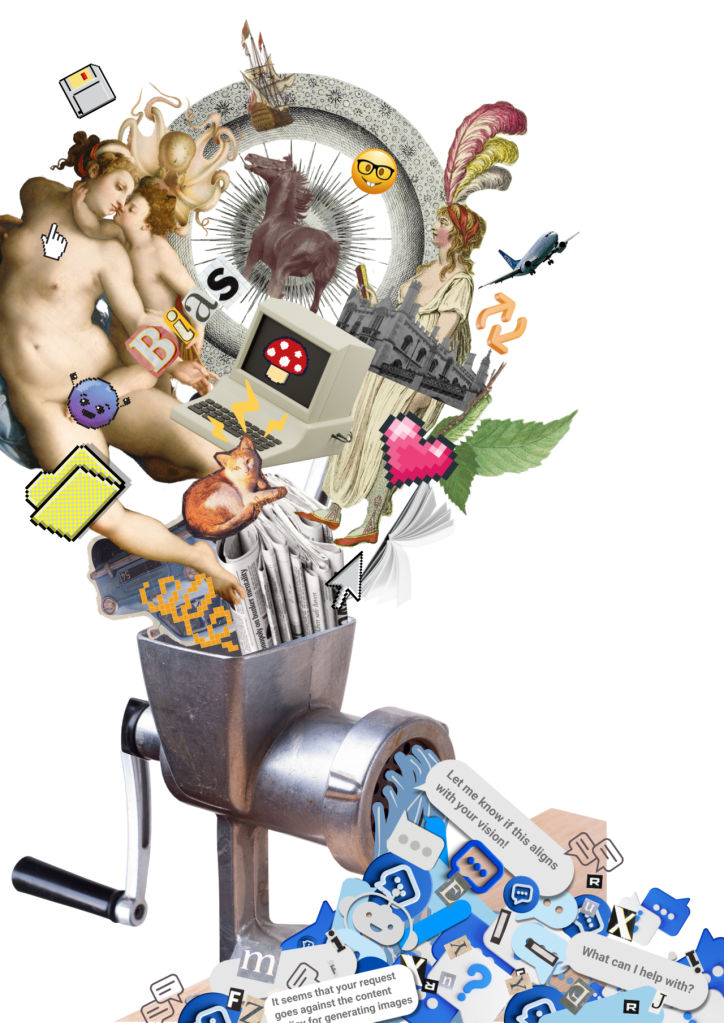
Image credit: Janet Turra & Cambridge Diversity Fund / https://betterimagesofai.org / https://creativecommons.org/licenses/by/4.0/ | Alt text: The image features a silver meat grinder. Going into the grinder at the top are various culturally symbolic, historical, and fun icons – such as emojis, old statutes, a computer, newspapers, an aeroplane. At the other end of the meat grinder, coming out is a sea of blue and grey icons representing chat bot responses like ‘Let me know if this aligns with your vision’ in a grey chat bot message symbol.
Description: The outputs of Large Language Models do seem uncanny often leading people to compare the abilities of these systems to thinking, dreaming or hallucinating. This image is intended to be a tongue-in-cheek dig, suggesting that AI is at its core, just a simple information ‘meat grinder,’ feeding off the words, ideas and images on the internet, chopping them up and spitting them back out. The collage also makes the point that when we train these models on our biased, inequitable world the responses we get cannot possibly differ from the biased and inequitable world that made them. Attributions – Studio of: Willem van de Velde II, Michele Tosini https://nationalgalleryimages.ie/groupitem/40/ This image was created using Canva: http://www.canva.com
Header image: “Data is a Mirror of Us.” Anne Fehres and Luke Conroy & AI4Media / https://betterimagesofai.org / https://creativecommons.org/licenses/by/4.0/ | Alt text: Collage with mirrors reflecting diverse human figures, symbolising AI data’s human origin and the ‘human in the loop’ concept. | Description: The aim of this image is to highlight that data, in both its ‘raw’ and reinterpreted form in AI systems, has a human origin. While moving through different seemingly abstract systems, a recognition of this origin highlights the notion of “human in the loop” and pushes back against the notion of AI as a ‘black box’. This work explores this idea through the symbolism of the mirror and reflection. While there is a magic in looking at the output of an AI system, there is also a need to ground this in the realism that such outputs are a reflection of society – the good and the bad. AI4Media https://www.ai4media.eu/ funded this commission which was made possible with funding from the European Union’s Horizon 2020 research and innovation programme under grant agreement No 951911. Creative direction by AIxDESIGN – aixdesign.co
 Expressive AI